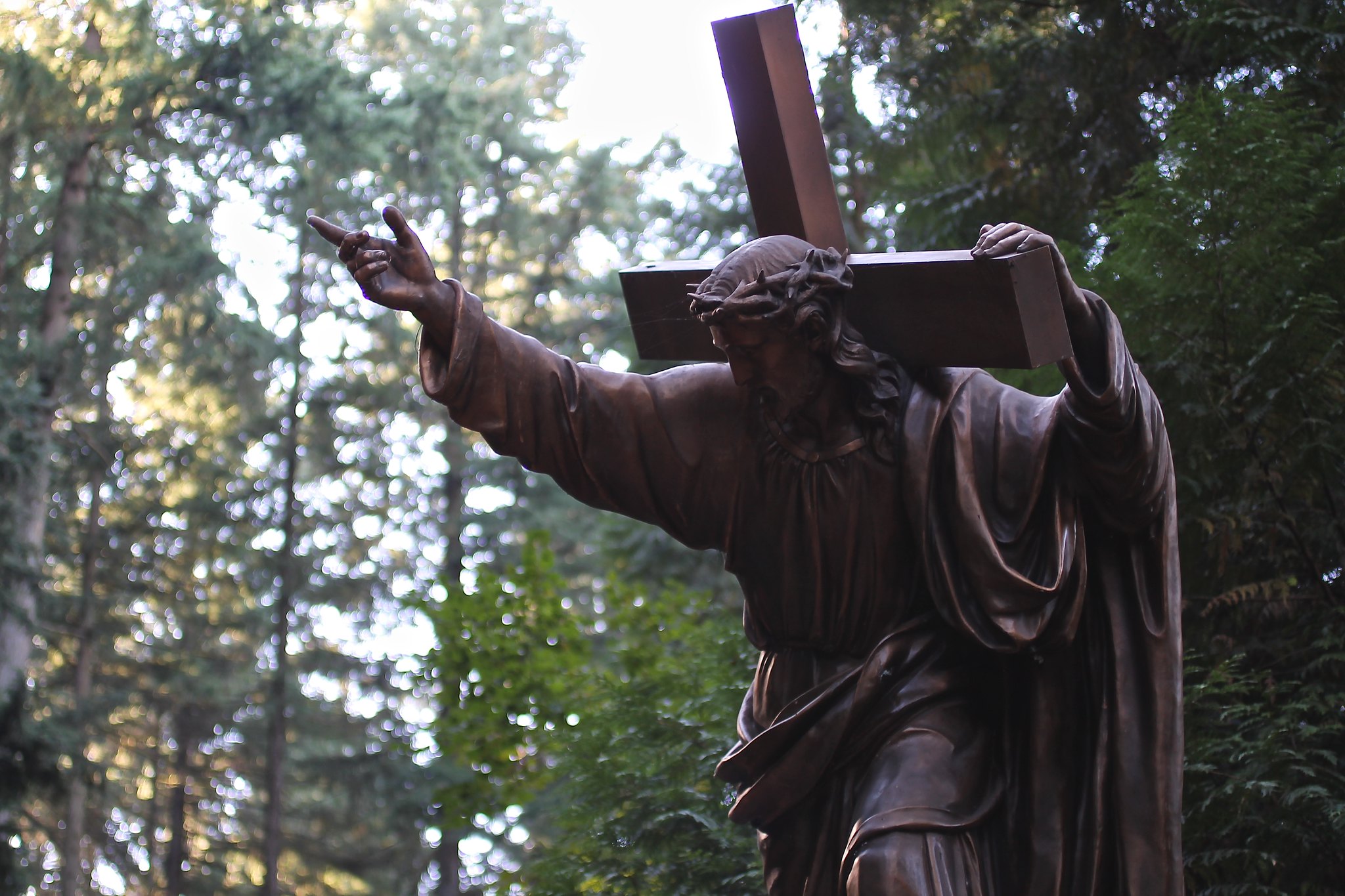
Even though the world does not know or understand us, we are to love the world as Jesus has loved us. This proves our status as children of God and allows us to participate in Jesus’ work of purifying the world.
Fourth Sunday of Easter – Year B
St. Luke’s Anglican Church – Georgetown, PA
Ezekiel 34:1-10
Psalms 23
I John 3:1-10
John 10:11-16
“See what love the Father has lavished on us in letting us be called God’s children! For that is what we are. The reason the world does not know us is that it has not known him.” (1 John 3:1 CJB)
Said another way: The reason the world does not understand us is that it has not known or understood God.
Early last week, a young man attacked an Assyrian Orthodox bishop as he celebrated the Eucharist in Sydney, Australia.[1] The attack was live-streamed, as this bishop is well-versed in using social media for the gospel and he was broadcasting the church service. As the congregants ran up and held down the attacker, the bishop reached out, put his hands on his assailant, and prayed for him.
After the attack, angry Christians rioted in front of The Good Shepherd Church.
Bishop Mar Mari Emmanuel then put out an audio message assuring people he was all right. He said in part:
Whoever you are and wherever you are, we need to understand that we need to be always thankful to our Lord and Saviour, Jesus Christ of Nazareth. For whatever trials and tribulations we go through, we are carrying the cross. Let us not forget that at all. The Lord Jesus said to us, if you do not carry your cross every day and follow me, you are not worthy to be my disciple. We thank the Lord Jesus for what took place in the last couple of days. I’m doing fine and recovering very quickly. We thank the Lord Jesus. So there is no need to be worried or concerned.

And a piece of advice to our beloved faithfuls. I need you to act Christ-like. The Lord Jesus never taught us to fight. The Lord Jesus never taught us to retaliate. …

For this is our master, our teacher, our leader, and our good shepherd who leads us to green pastures and still water. So my beloveds, I want you to always be calm. … we are Christians, and we need to act like it. Love never fails.[2]
Bishop Emmanuel went on to reiterate his forgiveness to the attacker:
I forgive whoever has done this act, and I say to him, you are my son. I love you, and I’ll always pray for you. And whoever sent you to do this, I forgive them as well. In Jesus’ mighty name, I have nothing in my heart but love for everyone. Whether that person is a Christian or not…
In many ways, Bishop Emmanuel has preached this sermon on 1 John 3 for me. But let us meditate longer on what John is saying to us.
This letter of First John was very clearly written by the same hand who wrote the Gospel of John. So much of the language is the same. This letter to one of John’s churches is unpacking the practicalities of living out Jesus’ teachings, especially the farewell words at the Last Supper, especially the new commandment: “Love one another as I have loved you.”
In First John, the apostle is combatting the false teaching that denied Jesus’ full humanity. But he is also calling Christians to love like Jesus, to love others more than we love our own lives.
There are three ideas from this passage I’d like us to focus on:
- The world does not know or understand us.
- Yet, we are to love the world as Jesus has loved us.
- Our showing of agape love proves our status as children of God and participates in Jesus’ work of purifying the world from sin.
The world does not know us or understand us. Bishop Emmanuel’s experience is one recent example of how the world does not get us.
Surely all of us have experienced rejection or hostility because we carry the name of Christ. And what we suffer here in the United States can hardly be called suffering most of the time. The real suffering is happening in places like Nigeria, China, Iran, and Russia[3].
- More than 8,000 Christians were murdered in Nigeria in 2023.[4]
- China continues to erode religious freedom in Hong Kong.
- Iran continues to arrest and imprison Christians.[5]
- Russia has increased harassment and persecution of Christians outside the Russian Orthodox Church, accusing Protestants of being American spies.[6]
Totalitarian regimes hate those who have found freedom in Christ. Islam cannot understand a God who suffers with us. The atheist cannot even conceive of god, or won’t because that would mean the human mind is not the ultimate arbitrator of what is good and just. With 8 billion souls on this planet, there would be 8 billion different standards for good and evil.
We who follow Jesus have submitted to the Creator. We’ve agreed to live by his standards, and the world does not understand it. “If the world hates you,” Jesus says, “know that it has hated me before it hated you” (John 15:18).
Unlike the world, we are not to hate back. Instead, we’re are to love – not only each other – but those who hate us.
How beautiful that Bishop Emmanuel was able to show love to the one who only moments before had cut him with a knife. At the communion table – where we are closest to Jesus in this fallen world – Bishop Emmanuel was able to imitate his Messiah. Jesus, with his dying breaths, said, “Father, forgive them for they know not what they do.”
They don’t know. The world does not know or understand God and his ways. We barely understand God’s ways. But we know him and we trust him.
Can we trust him enough to love those who offend us? Those that we think are politically blind? Those who betray us? Those who steal from us?
This love is agape. Not friendship love, or family love, or romantic love. The divine agape love loves without condition, loves when it is wounded, loves like God loves.
We cannot do that on our own. It is not our nature to love sacrificially. Our selfishness and pride say ‘Me first.’ But Jesus and the Holy Spirit within us tell us, motivate us to lay down our lives and love our attackers, our betrayers, the thieves in our lives.
And when we are able to pray blessing on our attackers, betrayers, and thieves, we prove that we are children of God. We do not earn our salvation or our adoption into the Kingdom of God. That is God’s free gift because of his agape love for us.
When we do good works – especially loving our enemies or loving that loved one that should have known better – we prove that we are surrendered to God’s standard and that the Holy Spirit is molding us into the image of Jesus, the Suffering Servant of God.
Not only do our good works prove our status as children of God, they speak that our sins are atoned for and that we are forgiven.
Let’s go back to our text, continuing in 1 John 3:2-3:
Beloved, we are God's children now, and what we will be has not yet appeared; but we know that when he appears we shall be like him, because we shall see him as he is. And everyone who thus hopes in him purifies himself as he is pure.
John is reminding the Beloved – those loved with agape love – that we are in the process of transformation. What we will be has not yet appeared, been made manifest, been revealed. Folks, we are saved by grace, but we are not yet glorified. We are not yet perfect. We know we are being made like Jesus, but we don’t exactly know what that looks like at the very end.
In the readings since Easter Sunday, we’ve heard of Jesus walking through locked doors, disappearing in one town and appearing in another place. His body is marked with the scars of the crucifixion. He snacks on some broiled fish. Will we get to walk through walls and translate from one continent to the next? We don’t know!
What John assures us is that when Jesus returns, we shall be like him and we shall see Jesus as he is. We’ll see Jesus face to face and know him fully.
Here’s the part that jumped out at me: “And everyone who thus hopes in him purifies himself as he is pure.”
Everyone who hopes in Jesus the pure one, who expects to be made more like Jesus by the Holy Spirit, purifies him or herself.
To purify oneself here has multiple senses:[7]
- One can purify something or oneself in preparation for worship
- or one can perform a rite of atonement
- or one can purify one’s morality and actions, setting oneself apart by doing good works.
In the context of John’s assertion that our actions reveal whether we are children of God or children of the devil, the third definition is plain. When we choose love, we are purifying our choices, we are continuing to set ourselves apart for God, we are continuing to allow God to make us like Jesus, to make us pure like he is.
We cannot dismiss, though, the first definitions related to the Levitical worship system, to the temple, and to blood sacrifice.
One of the first things John’s Gospel commands us is to “Behold, the Lamb of God who takes away the sin of the world!”
Tomorrow at sunset, according to the Hebrew calendar, Passover begins. This year, the Christian and Jewish calendars diverge so that Holy Week and Passover are a month apart. I will be going on Friday to a Passover seder hosted by two Messianic Jewish congregations here in the Pittsburgh area and remembering afresh that Jesus is our Passover lamb. Here at St. Luke’s, we’ll participate in a compressed Passover seder shortly as we celebrate the Eucharist together.
Jesus’ ministry on earth climaxed just as all of Israel was preparing for Passover. As the priests in the temple were slaughtering lambs to be eaten in every Jewish household that night, Jesus was being executed on Calvary.
Just as the Children of Israel were told in Exodus to eat unleavened bread and roasted lamb so that the judgment of God would pass over their homes, Jesus calls us to eat his sinless flesh and drink his blood so that God’s judgment will pass over us.
There’s more though. John the Baptist says this Lamb of God takes away the sin of the world. The Passover doesn’t speak explicitly about sin, though God was judging Egypt for their idolatry and rebellion. Actually, God was judging all who lived in Egypt. Any Israelite firstborn who wasn’t in a house marked with blood that first Passover would have died. All have sinned and come short of the glory of God.
When we think of a lamb taking away sin, we should think of another biblical holy day: Yom Kippur, the Day of Atonement. John the Evangelist has that in mind.
Later in 1 John 4 (v. 10 CJB) John reminds us what love is:
not that we have loved God, but that he loved us and sent his Son to be the kapparah for our sins. Beloved friends, if this is how God loved us, we likewise ought to love one another.
Most Bible translations will say that God sent his Son to be the propitiation for our sins. Gosh, that’s a big word. How about atonement? The translation I read said kapparah, the Hebrew word for atonement.
Do you hear the linguistic relationship between Yom Kippur and kapparah?
Forgive me for the Hebrew lesson. I highlight these words for atonement to point us back to the context of Jesus’ sacrifice for us. You can read many books on atonement theory, how Jesus’ death on the cross works to wash away our sins. My books of choice? Leviticus and Hebrews. Together, they explain how Jesus is the Yom Kippur sacrifice.
Not only is he the atoning sacrifice, but he is also the Great High Priest who goes into the Holy of Holies with his own blood to wash away the sin that has polluted all creation and even heaven itself (Heb 9:23-24ff[8]). Yes, the sin of humanity reached even the courts of God but Jesus, the Son of Man, takes away the sin of the world.
When we choose love, we prove that our sins have been covered by the blood of the lamb, that we have accepted Jesus’ atoning sacrifice and allowed it to wash our guilt away.
But John presses us further: “ Beloved friends, if this is how God loved us, we likewise ought to love one another.”
God loved us by forgiving our sins. So should we love one another, love the least and lost (Matt 25:31-46), and love even our enemies. In the Sermon on the Mount, Jesus tells us, “Love your enemies and pray for those who persecute you, so that you may be sons of your Father who is in heaven” (Matt 5:43-48).
When we die to ourselves, when we lay down our need to be justified after we are wronged, when we forgive, we are participating in Jesus’ atonement. We are imitating God. We are participating in God’s work of purifying us, the person we forgive, and the whole world.
When we forgive, the world will not understand us. It may even hate us. But when we forgive like Jesus, when we love like that, many in the world will ask questions. They’ll want to know how we can love our enemies.
Because Jesus.
The answer is always Jesus. We are imitating what our Rabbi Jesus does. We are loving like Messiah Jesus. We are learning to be like our Jesus. We are sharing the love and forgiveness he pours out on us.
Beloved, “Keep loving one another earnestly, since love covers a multitude of sins.” (1 Pet 4:8 quoting Prov 10:12).
Let us pray.
Almighty God, you gave your only Son to be for us both a sacrifice for sin and an example of godly living: Give us grace thankfully to receive his inestimable benefits, and daily to follow the blessed steps of his most holy life; through Yeshua the Messiah our Lord, who lives and reigns with you and the Holy Spirit, one God, for ever and ever. Amen.
Footnotes
[1] Tiffanie Turnball, “Sydney Church Stabbing: Australian Bishop Forgives Alleged Attacker,” BBC.com, 18 April 2024. https://www.bbc.com/news/world-australia-68814813.
[2] “A Message from Bishop Mar Mari Emmanuel ‘The Lord Jesus Never Said, Go out and Fight on the Street.’” THE OTHER CHEEK, 17 April 2024. https://theothercheek.com.au/a-message-from-bishop-mar-mari-emmanuel-the-lord-jesus-never-said-go-out-and-fight-on-the-street/.
[3] “Russia’s War Against Evangelicals.” TIME, 20 April 2024. https://time.com/6969273/russias-war-against-evangelicals/.
[4] Ngala Killian Chimtom, “Report: 8,000 Nigerian Christians murdered in worst year for Islamist attacks,” Catholic Herald, 16 Feb 2024. https://catholicherald.co.uk/eight-thousand-nigerian-christians-murdered-in-worst-single-year-for-islamist-attacks-says-report/
[5] “REPORT: Iranian Christians suffer an increase in religious persecution,” All Arab News, 11 Mar 2024. https://allarab.news/report-iranian-christians-suffer-an-increase-in-religious-persecution/
[6] Peter Pomerantsev, “Russia’s War Against Evangelicals.” TIME, 20 April 2024. https://time.com/6969273/russias-war-against-evangelicals/.
[7] William Arndt et al., “ἁγνίζω,”A Greek-English Lexicon of the New Testament and Other Early Christian Literature (Chicago: University of Chicago Press, 2000), 12.
[8] Cf. Jacob Milgrom’s discussion of Day of Atonement in Leviticus: A Continental Commentary.
Photo credit: Fio via Flickr (cc)