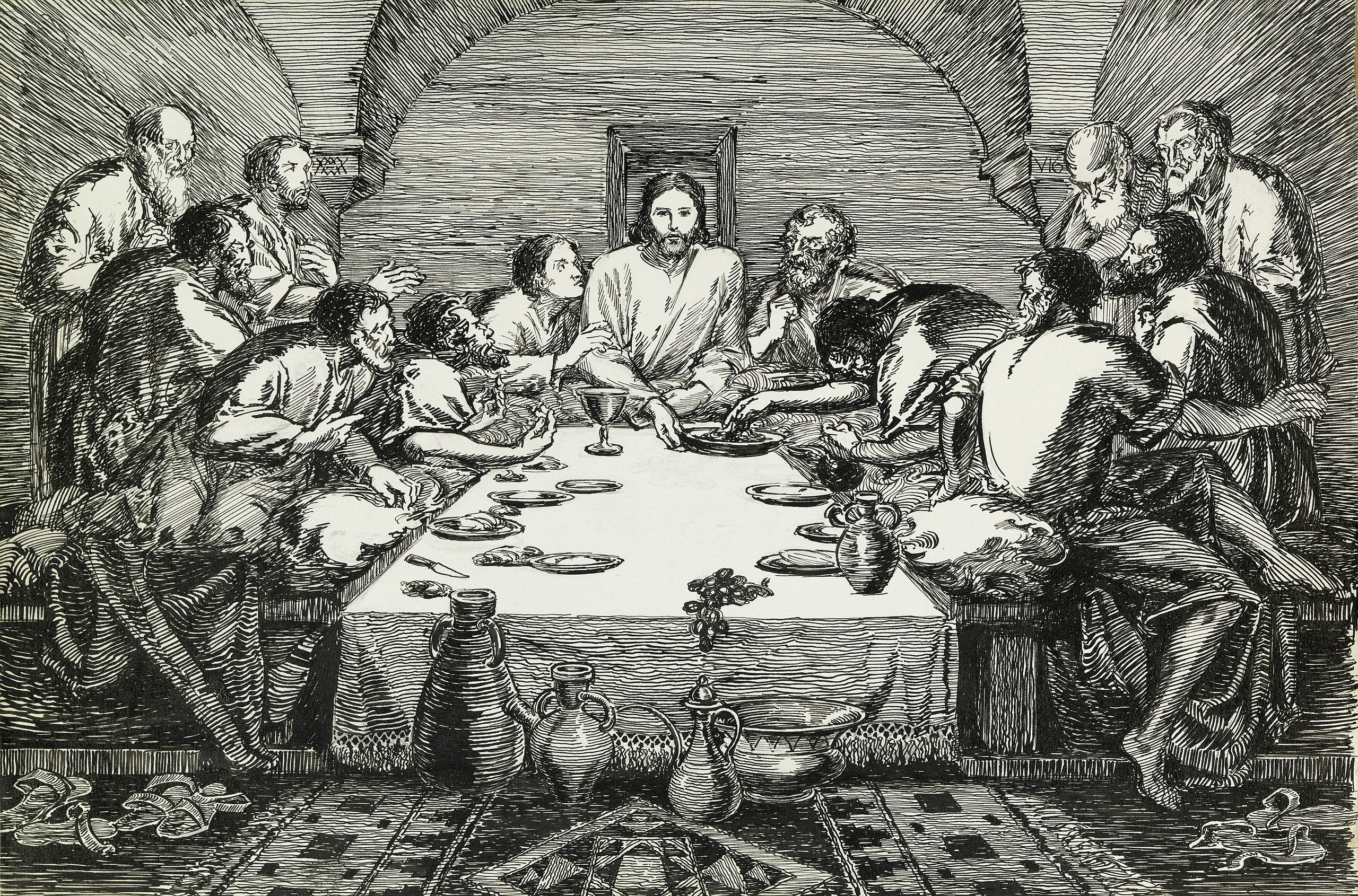
This sermon was preached toward the end of Lent at Christ Our Redeemer Anglican Church in Oklahoma City, but it is posted now as Passover approaches.
Fifth Sunday in Lent | Passion Sunday
Jeremiah 31:31–34
Psalm 51
Hebrews 4:14–5:10
John 12:20–36
Shalom, friends.
We are nearing the end of our Lenten journey. Today is Passion Sunday when we begin to anticipate the events of Holy Week. So it is appropriate that today we will consider how Passover plays an important role in the death and resurrection of Jesus the Messiah.
We will start with the passage from Jeremiah 31 we heard a bit ago.
Before we jump in, I encourage you to be like the Bereans, a group of Jews mentioned in Acts 17 whom Luke called noble “as they received the word with all eagerness, examining the Scriptures daily to see if these things were so.” In short, don’t take my word for it.
Jeremiah 31:
31 “Behold, the days are coming, declares the Lord, when I will make a new covenant with the house of Israel and the house of Judah, 32 not like the covenant that I made with their fathers on the day when I took them by the hand to bring them out of the land of Egypt, my covenant that they broke, though I was their husband, declares the Lord. 33 For this is the covenant that I will make with the house of Israel after those days, declares the Lord: I will put my law within them, and I will write it on their hearts. And I will be their God, and they shall be my people. 34 And no longer shall each one teach his neighbor and each his brother, saying, ‘Know the Lord,’ for they shall all know me, from the least of them to the greatest, declares the Lord. For I will forgive their iniquity, and I will remember their sin no more.”
What is the context of Jeremiah 31?
Jeremiah is one of the last voices warning the Kingdom of Judah that judgment is coming. The Israelites repeatedly were not faithful to God as they had promised in the time of Moses.
God frees Israel from slavery in Egypt and whisks them away into the wilderness. At Mount Sinai, God and Israel promise to be faithful to one another. The analogy is a marriage relationship.
But Israel becomes a wayward spouse and worships other gods and fails to care for the most vulnerable in society. God is patient for more than 400 years. But enough is enough. God enacts the judgment clauses of the nuptial agreement (aka the Torah) and sends Babylon to judge Israel. The people are forcibly removed from the Promised Land.
But even as God pronounces judgment through Jeremiah, God offers comfort. When God judges, he always offers comfort and he always makes a way for restoration. So here in Jeremiah 31, God restates his commitment to Israel.
God promises to make a new covenant with the 12 tribes of Israel. This new covenant will differ from the Mosaic covenant, not necessarily in content but in execution. The content is still the Law. Law – that’s such a heavy word. When you read Law in the Scriptures, think Torah, think Community Instruction. The Torah is God’s guide to how we are to relate to him and to each other.
In his New Covenant with Israel, God promises
- to “put my law within them, and I will write it on their hearts.” Torah, God’s community instruction, will no longer be external to be learned in a human way. It will instead be internally recorded and taught by the Holy Spirit. God will write it on their hearts.
- “I will be their God, and they shall be my people.” This is the same as in the Mosaic Covenant. God promises to make Israel his treasured people. Israel’s part is to make God their treasured life partner.
- “No longer shall each one teach his neighbor and each his brother, saying, ‘Know the Lord,’ for they shall all know me, from the least of them to the greatest, declares the Lord.” This is a promise of a personal relationship with God for everyone, no matter your social status, your financial status, your educational status, your marriage status, your health status. Every Israelite in the New Covenant will know God personally.
- “For I will forgive their iniquity, and I will remember their sin no more.” In the New Covenant, God promises to forgive and forget the sins of his people, the infidelity to him and to each other.
Again, the New Covenant promises that
- God’s instruction will be written on the heart
- Israel will be God’s people and he will be their God.
- Each Israelite will have a personal relationship with God.
- Israel’s sin will be forgiven and forgotten.
To whom are these promises of a New Covenant made? To Israel and Judah. To the 12 tribes of Jacob.
Has God kept this promise of a New Covenant? When and how?
If you’ve got a Bible, go with me to Luke 22.
We call the “Christian” half of the Bible the New Testament or New Covenant. If you’ve ever wondered why, the answer is Jeremiah 31 and Luke 22.
Luke 22:1, 14–20 (ESV):
1 Now the feast of Unleavened Bread drew near, which is called the Passover.14 And when the hour came, he reclined at table, and the apostles with him. 15 And he said to them, “I have earnestly desired to eat this Passover with you before I suffer. 16 For I tell you I will not eat it until it is fulfilled in the kingdom of God.” 17 And he took a cup, and when he had given thanks he said, “Take this, and divide it among yourselves. 18 For I tell you that from now on I will not drink of the fruit of the vine until the kingdom of God comes.” 19 And he took bread, and when he had given thanks, he broke it and gave it to them, saying, “This is my body, which is given for you. Do this in remembrance of me.” 20 And likewise the cup after they had eaten, saying, “This cup that is poured out for you is the new covenant in my blood.”
Did you catch that? In verse 20, Jesus says, “This cup which is poured out for you is the new covenant in my blood.” Jesus, the Word of God made flesh, pronounces the start of the New Covenant of Jeremiah 31 at the Last Supper. Or maybe we should call it the First Passover of the New Exodus. What do I mean? Let’s back up a bit and talk about Passover and the Torah’s promise of a Prophet like Moses.
We saw in Jeremiah 31 that God referenced “the covenant that I made with their fathers on the day when I took them by the hand to bring them out of the land of Egypt.” For reasons we won’t cover today, the people of Israel wound up enslaved in Egypt. They cried out for salvation, and God raised up Moses. Through Moses, God brought judgment on Egypt for their idolatry and for enslaving Israel.
God’s final judgment on Egypt will affect all those who live there. But he makes a way of protection: the Passover meal. Remember, God’s ways are not our ways.
In Exodus 12, God tells Israel how to protect themselves from the coming judgment. They are to kill a sheep or a goat, put its blood over the door, roast the lamb, and eat it with unleavened bread. All peoples – Israelite or Egyptian – in houses where this meal is eaten are saved from God’s judgment on Egypt.
God judges Egypt with 10 plagues. The 10th plague breaks the will of Egypt, and Egypt finally lets Israel go. They are saved!
God commanded that this salvation meal be remembered every year. To this day, Jewish families gather every Passover to remember how God saved them from Egypt.
In the thousands of years since the Exodus, the Passover meal has evolved. It’s always included unleavened bread or matzah. By the time of Jesus, wine had been added as a symbol of joy and as a symbol of God’s four promises to Israel in Exodus 6 (vv. 6-7):
- I will bring you out from under the burdens of the Egyptians
- I will deliver you from slavery to them
- I will redeem you with an outstretched arm and with great acts of judgment.
- I will take you to be my people, and I will be your God.
The Passover remembers how God fulfilled those promises in Exodus through Moses.
Later, as Moses is finishing his course, God tells him that he will send Israel another great leader: “ I will raise up for them a prophet like you from among their kinsmen. I will put my words in his mouth, and he will tell them everything I order him” (Deut 16:18).
Israel has been looking for the Prophet Like Moses since. Not only that, they expect a New Exodus as promised by Isaiah, Jeremiah, Hosea, Micah, and Zechariah![1] They are looking for that day when scattered Israel is brought out from exile, delivered from persecution, redeemed from the nations that oppress them, and together taken again by God as a nation in the land promised to Abraham.
Next time you’re reading through the Hebrew scriptures, particularly the Psalms and the Prophets, notice how often the Exodus story comes up. It is the template for God’s interaction with Israel over and over again.
Once you notice this, it makes perfect sense that the climax of Jesus’ earth ministry takes place at Passover. Passover is when Israel expects to be redeemed, when they expect God to act. He just doesn’t act the way they expect him to. His ways are not our ways. His thoughts are not our thoughts.
I recently read The Nazarene, a novel based on the Gospels by Jewish writer Sholem Asch. It was published in 1938. Like The Chosen on TV today, The Nazarene puts Jesus back in his Jewish context and teases out details non-Jews might miss.
In the novel, Asch does a good job of giving you a sense of the messianic expectation that arose every Passover. Was this the year God would throw off the Roman oppressors? Who in the Jewish community was with the latest revolutionary? Who was opposed to an uprising for political, financial, or religious reasons?
And what of this Jesus of Nazareth who preaches an elevated Torah in the Sermon on the Mount, who provides bread from heaven to feed the 5,000, who speaks to Moses and Elijah on the Mount of Transfiguration? Is he the Messiah? Is he the Prophet Like Moses? Is he the Son of God?
The answer to these questions are in the Passover meal we see Jesus have with his disciples. Back to Luke 22:
14 And when the hour came, he reclined at table, and the apostles with him. 15 And he said to them, “I have earnestly desired to eat this Passover with you before I suffer. … 17 And he took a cup, and when he had given thanks he said, “Take this, and divide it among yourselves.”
We see Jesus take wine twice in Luke 22. More than likely, Luke records the first and the third cup of the Passover meal.
For those of you who came to the Shabbat dinner on Friday, you know that a Jewish feast is opened by blessing the wine first. When it says Jesus gave thanks, he likely prayed Baruch ata Adonai Eloheinu, Melech HaOlam, bore pri hagefen (Blessed are you LORD God, King of the Universe, who brings forth the fruit of the vine) and had them all drink.
Luke next says,
19 And he took bread, and when he had given thanks, he broke it and gave it to them, saying, “This is my body, which is given for you. Do this in remembrance of me.”
With the help of Matthew’s Passover account (Matt 26:26), we know that this happens while they are eating. So Jesus pauses the meal, blesses a piece of matzah – Baruch ata Adonai Eloheinu, Melech HaOlam, hamotzi lehem (Blessed are you LORD God, King of the Universe, who brings forth bread from the earth )– and says the bread represents his body.
This is highly unusual, not just equating the bread to his body but the timing of the eating of the bread. The last thing you were supposed to eat – in Jesus’ time – at the Passover meal was the Passover lamb. But Jesus has them eat bread last and says, “This is my body, which is given for you.”
With this action, Jesus is saying, “I am the ultimate Passover lamb.”
I can hear John the Baptist at the Jordan River crying out, “Behold, the Lamb of God who takes away the sin of the world!” Paul affirms this by saying Jesus is our Passover sacrificed for us (1 Cor 5:7).
Then we see Jesus take wine again after supper, Luke 22:20: “This cup which is poured out for you is the new covenant in my blood.”
This is the third cup of the Passover meal, the Cup of Redemption.
This is significant. With the Cup of Redemption, Jesus announces the arrival of New Covenant promised through Jeremiah centuries before. He announces it to his Jewish disciples. He is in effect saying, I am the Prophet Like Moses. This is the new exodus. I am writing my Torah on your heart.
When we come to the Communion table, we are partaking in a compressed Passover meal. That’s why the Anglican liturgy gives the option for the priest to say, “Christ, our Passover sacrificed for us.” And the people respond, “Therefore, let us keep the feast.”
We are remembering Jesus’ death until he comes, as he asked us to. We are also stepping into the New Covenant promised to Israel and Judah.
How can we, as non-Jews, step into this promise? Because God chose Abraham on our behalf. The call of Abraham was always to bless the nations. Which nations? All the nations that rebelled at the Tower of Babel (that’s us). “In you,” God tells Abraham, “all the families of the earth will be blessed” (Genesis 12:3).
In the New Covenant, God promises those – Jew and Gentile – who sign on that
- He will write his good instruction on our heart.
- We will be God’s people and he will be our God.
- We will have a personal relationship with God.
- Our sins will be forgiven and forgotten.
God will judge the sin of this world as he judged Egypt. Every injustice will incur God’s wrath. We are all sinners. We have all been unjust. We all deserve God’s wrath.
But he has made a way of forgiveness, of protection, of redemption. We need only take on the blood of Jesus, the ultimate Passover lamb, upon the door of our hearts. We need only come to the Communion table at his invitation and celebrate his victory over sin and death by eating his bread and drinking his wine.
Let us pray.
O God, whose wonderful deeds of old shine forth even to our own day, by the power of your mighty arm you once delivered your chosen people from slavery under Pharaoh, to be a sign for us of the salvation offered to all nations by the water of Baptism: Grant that all the peoples of the earth may be numbered among the offspring of Abraham, and rejoice in the inheritance of Israel; through Yeshua HaMashiach Adoneinu. Amen.
[1] A. Chadwick Thornhill, “Exodus,” The Lexham Bible Dictionary (Bellingham, WA: Lexham Press, 2016).