First Sunday in Lent – Year B
Sewickley United Methodist Church
Lenten Ecumenical Service
Genesis 9:8-17
Psalm 25:1-10
1 Peter 3:18-22
Mark 1:9-15
Shalom, friends.
It’s already Lent! When did this happen?
We started this preparatory season with Ash Wednesday, when we were reminded that we all will die. After Transfiguration Sunday, we began our walk to Jerusalem with Jesus of Nazareth, where he goes to die. But we know what the disciples so struggled to see: that Jesus, Son of God, Son of Man, had to die and so must we so that we can all receive Jesus’ resurrection life!
In December, my Best for Eternity Friend Necia died of colon cancer. She is an amazing servant of God who was the long-time administrator and music director of a small Baptist church in Cardiff, Wales.
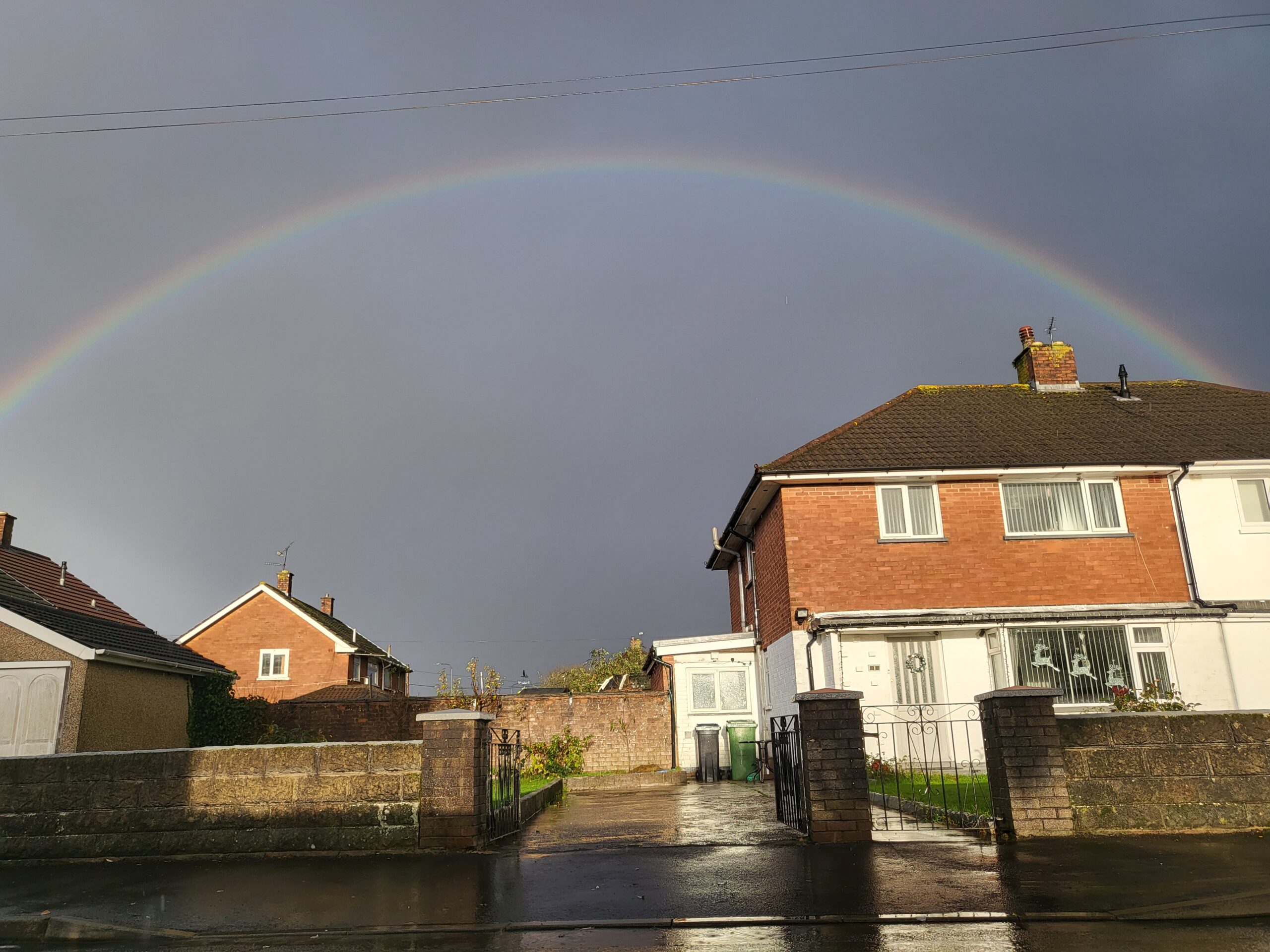
The sun shone brightly on her hospice bed the morning Necia died, then the day turned dark and rainy – as Cardiff and Pittsburgh do. However, after I picked up her dog from a friend, the sun broke forth again and a bright rainbow lit the Cardiff sky.
The angels had put out the rainbow bunting for Necia’s arrival, and God let us on earth catch a glimpse of her homecoming and perhaps even of his throne. So rainbows have been on my mind.
Context of Genesis 9
In Genesis 1 and 2, God created the world and humanity and called it all good. Then Adam and Eve fell for the Serpant’s temptation to rebel. Their son Cain also succumbed to murderous temptation and killed his brother Abel. By Genesis chapter 6, all creation is in chaos.
5 The Lord saw that the wickedness of humans was great in the earth and that every inclination of the thoughts of their hearts was only evil continually. 11 Now the earth was corrupt in God’s sight, and the earth was filled with violence. 12 And God saw that the earth was corrupt, for all flesh had corrupted its ways upon the earth.
Creation wasn’t just in chaos. It was in ruin, spoiled, injured. It was filled with violence. That word violence first appears here, in Genesis 6 and throughout Scripture denotes destruction, iniquity, blood, sickness, malice, oppression – in a word, sin.
Adam and Eve’s cancer of rebellion had metastasized and spread to every human in the worst way. Rabbinical texts posit that the violence and corruption had spread even among the animals.
13 And God said to Noah, “I have determined to make an end of all flesh, for the earth is filled with violence through them. Behold, I will destroy them with the earth.”
Why did God tell Noah? What was special about Noah? Were he and his family sinless? No, as is proved after the flood. Why Noah?
Noah was listening. He heard God calling in the midst of the world’s chaos and he listened. He heard and trusted God’s instruction to build an ark.
The world was filled with violence and deserved the consequences of its rampant sin. Noah, too, deserved the consequences. Yet, God made a way of mercy. Noah heard God’s merciful voice, trusted, and obeyed.
After the flood, Noah offers God worship in the form of a burnt sacrifice.
21 And when the Lord smelled the pleasing odor, the Lord said in his heart, “I will never again curse the ground because of humans, for the inclination of the human heart is evil from youth; nor will I ever again destroy every living creature as I have done. (Gen 8)
Notice that in this pronouncement to never again curse the ground because of humanity, God acknowledges that the human heart tilts toward sin from youth. Still, God is pronouncing mercy on sinful humanity. The flood did not cure Noah’s sinful heart. Yet, God will have mercy on his descendants and all creation. It’s not just a promise. It’s a covenant oath.
Covenant of mercy
Covenants are usually solemn agreements between two parties, with responsibilities and conditions for both. Marriage is a covenant most of us are familiar with.
But God’s covenant with Noah is unilateral. God is making a promise to Noah and all humanity and all living creatures. God promises to never again cut off all flesh “by the waters of a flood, and never again shall there be a flood to destroy the earth.” This is in the global context, as we know we still have localized floods. The responsibilities of the covenant are God’s alone. There is nothing for Noah or the rest of humanity to do to obtain this mercy.
God gives us a global sign of this covenant promise, the natural phenomenon we call a rainbow.
Why a rainbow?
Rainbows have multiple meanings across cultures. In Ireland, it’s good fortune. In Greek mythology, the goddess Iris connects humans to the other gods. In Norse religion, the rainbow is the bridge to Asgard. Many other cultures link the rainbow to the spiritual realm, to bad omens, and to birth and healing.
“In the 1990s, Archbishop Desmond Tutu and President Nelson Mandela described the newly democratic South Africa as the ‘rainbow nation’.” And the LGTBQ+ community has used a rainbow as a symbol since the late 70s. There’s a whole Wikipedia page with many other rainbow flags throughout history.
But what does God mean – in the biblical context – by the rainbow? Why is this the sign of his mercy, other than rain droplets refract sunlight and break it into many colors?
There are two reasons I see.
- In Hebrew, Genesis 9:13 just says, “My bow have I set in the clouds.” Not rainbow, but bow, as in bow and arrow. So God said, “My weapon have I set in the clouds.” If we see the rainbow as an archery bow, we see that it is pointing upward. God has hung his weapon in the sky pointing away from us as a marker of his mercy. He’s promising not to use that weapon – the weapon of rain – in his armory against the whole planet anymore.
- The rainbow shows up only three more times in Scripture: once in Ezekiel and twice in Revelation.
- In Ezekiel 1, the prophet has a vision of heaven: 28 Like the appearance of the bow that is in the cloud on the day of rain, so was the appearance of the brightness all around. Such was the appearance of the likeness of the glory of the Lord.
The glory of God looks like a rainbow. - In Revelation 4, John sees the throne of God: 3 And he who sat there had the appearance of jasper and carnelian, and around the throne was a rainbow that had the appearance of an emerald.
The point of the gemstones is to give us impressions of the rainbow colors John sees shining from and around the throne, like what Ezekiel sees. God sitting on his throne looks like the colors of the rainbow. - The rainbow in the sky, then, is a symbol of God with us. It’s a glimpse at his glory, and his throne.
- In Ezekiel 1, the prophet has a vision of heaven: 28 Like the appearance of the bow that is in the cloud on the day of rain, so was the appearance of the brightness all around. Such was the appearance of the likeness of the glory of the Lord.
God created us to dwell with us. As God re-creates the world post-flood, God is restating, “I am here with you.”
The rainbow is God’s skywriting: “I love you even though you’re broken. I am here even when you can’t get it right. I am Immanuel.”
In Matthew 1, a man named Joseph learns that his fiancee is pregnant, and not by him. He’s a good man, so he decides he’ll break the engagement quietly so as not to shame Mary.
20 But just when he had resolved to do this, an angel of the Lord appeared to him in a dream and said, “Joseph, son of David, do not be afraid to take Mary as your wife, for the child conceived in her is from the Holy Spirit. 21 She will bear a son, and you are to name him Jesus, for he will save his people from their sins.” 22 All this took place to fulfill what had been spoken by the Lord through the prophet:
23 “Look, the virgin shall become pregnant and give birth to a son,
and they shall name him Emmanuel,” which means, “God is with us.”
24 When Joseph awoke from sleep, he did as the angel of the Lord commanded him; he took her as his wife 25 but had no marital relations with her until she had given birth to a son, and he named him Jesus. (Matt 1).
Joseph, like Noah, was listening when God called. The announcement of a virgin birth was as ridiculous as a call to build an ark to house every type of land animal. But Joseph believed and obeyed and was surrogate father to the Son of God.
The message of the Bible from Genesis to Revelation is God loves us and he is with us. He goes to great lengths to be near humanity, even though our hearts incline toward selfishness and pride:
- He created the Garden of Eden for us.
- He redeems us from slavery in Egypt.
- He has us build a tent for him so he can wander in the wilderness with us.
- He goes into exile with us.
He lays down his heavenly glory and becomes flesh and blood like us. He grieves at the death of his friend Lazarus. He mourns over Jerusalem, the city of the great king, when they cannot believe him. He bears the betrayal of his closest friends. He is physically punched and kicked and mocked. He is whipped and lacerated. He is nailed to a Roman cross. He dies… all to be with us.
God established a covenant of mercy through Noah with all creation. The rainbow is the witness of this covenant. The rainbow covenant still stands and is finalized in the death and resurrection of Jesus the Messiah. The rainbow points to another strange symbol of mercy: the cross.
Our days are not unlike Noah’s. Creation is in ruin, spoiled, and injured. Our world is filled with violence, destruction, iniquity, blood, sickness, malice, oppression – in a word, sin.
Like Noah, God is calling us to leave the violence and wickedness of this world and find shelter and mercy in the arms of Jesus the Messiah.
Let us listen to the small still voice of mercy and answer with faith, repentance, and love.
In the name of the Father, Son, and Holy Spirit. Amen.
Footnotes
[1] Francis Brown, Samuel Rolles Driver, and Charles Augustus Briggs, “שָׁחַת,” Enhanced Brown-Driver-Briggs Hebrew and English Lexicon (Oxford: Clarendon Press, 1977), 1007
[2] H. Haag, “חָמָס,” Theological Dictionary of the Old Testament (Grand Rapids, MI; Cambridge, U.K.: William B. Eerdmans Publishing Company, 1980) 480.
[3] Genesis 6, Complete Jewish Bible with Rashi Commentary, Chabad.org. https://www.chabad.org/library/bible_cdo/aid/8171/showrashi/true/jewish/Chapter-6.htm#lt=primary
[4] The verses preceding the rainbow passage give Noah and his family basic ethical guidelines: no murder, no eating still-living animals. The Jewish sages call these the Noahide Laws and say they apply to all humanity. Because they come after God blesses Noah and before the mention of the rainbow covenant, they cannot be Noah’s part of the covenant. God does not place any caveats or prerequisites on the rainbow covenant.
[5] “Rainbows in Mythology.” Wikipedia, Wikimedia Foundation, 8 Feb. 2024, en.wikipedia.org/wiki/Rainbows_in_mythology. Accessed 17 Feb. 2024.
[6] “Rainbows in Culture.” Wikipedia, Wikimedia Foundation, 7 Feb. 2024, en.wikipedia.org/wiki/Rainbows_in_culture. Accessed 17 Feb. 2024.
[7] Nahum M. Sarna, Genesis, The JPS Torah Commentary (Philadelphia: Jewish Publication Society, 1989), 63.
[8] @Birdchadlouis, “God’s Retired Weapon קשׁת,” X (Formerly Twitter), 3 Jan 2024. https://twitter.com/birdchadlouis/status/1742528603726757948.
[9] Robert G. Bratcher and Howard Hatton, A Handbook on the Revelation to John, UBS Handbook Series (New York: United Bible Societies, 1993), 89.