Editor’s note: This post is a reworking of this writing from early 2024. I rewrote it, adding portions from Waiting for death, servant of God, after I was asked to present it as a spoken word piece for The Way of Cross, an event hosted by The Sparks House. I also created the photo montage, which was projected on the narrow wall behind the altar as the 14th station of the cross. All the photos of various religious artworks were taken by me over the course of 10 years in the United States, England, Spain, Poland, Jordan, and Israel.
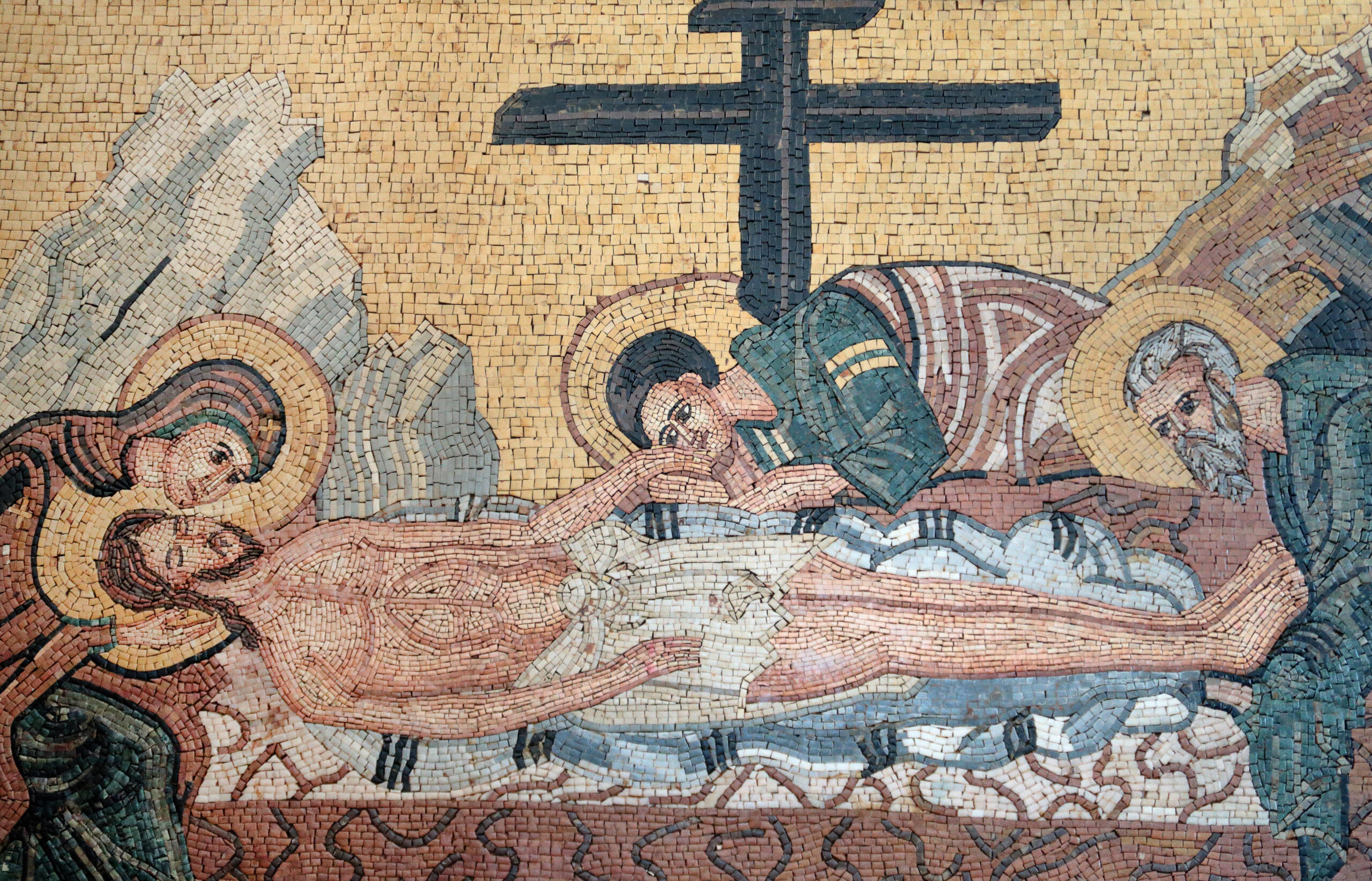
I used to worship at a church that had an icon we affectionately called Dead Jesus. When I first started attending the church, it was the only altar icon we had. In it, Jesus is wrapped in burial cloths so that only his face is visible, and Mary lovingly embraces her dead son.
Dead Jesus was up nearly year-round when I first attended this church. The only time the icon was put away was for the seven weeks of the Easter season. It’s hard to celebrate the Resurrection when you’re looking at Dead Jesus.
Happily, in the past few years, the church has acquired other icons, like Resurrected Jesus and The Last Supper. Still, at Lent, Dead Jesus comes back out and remains up through Holy Week.
Who wants to see Dead Jesus? I didn’t when I started worshiping at that church. All the Protestant arguments against crucifixes surfaced.
- He’s not on the cross anymore.
- The tomb is empty. Jesus is alive, sitting at the right hand of the Father.
All true. Who wants to see Dead Jesus?
In 2022, I glimpsed Jesus in my dying aunt Connie.
As the family was sitting vigil at my aunt’s home, my cousins noticed my aunt’s temperature was quite warm. When they uncovered her feet to cool her off, my aunt’s feet were crossed arch-over-bridge, not unlike Jesus’ feet in so many crucifixes.
Later, my cousin Pam rose suddenly and went to her mother. Pam pumped lotion into her hands and gently creamed her mother’s feet, still crossed. In Pam’s urgent action I saw Mary of Bethany anointing the feet of Jesus before his death (John 12).
A little later, Connie thirst and asked for a drink. My cousin Rita raised a bottle to her lips. I couldn’t help but think of Jesus asking for a drink from the cross. I prayed, “Oh beloved Yeshua, be near as Mary and John were at your dying.”
My aunt would die a few days later after more than 91 years of vibrant life.
Waiting for death is odd and foreign. Humanity was not created to die. Yet, it is appointed for each of us to die once (Heb 9:27).
Death is odd and foreign to us. It hurts like nothing else. Be comforted. The Author of life steps into death with us to so that we might have eternal life.
Not long ago, I again saw Jesus as I watched cancer snuff out the life of my best friend. But this time death was early, much too early.
As we prayed for healing, as we hoped for recovery, I needed to see Dead Jesus. After she died, the icon of Dead Jesus was the Jesus I needed to see.
Who wants to see Dead Jesus? Me, it seems.
I grew up in a church full of disaffected Catholics. Iconography was looked down upon. As a younger Christian, I made all the arguments against icons and crucifixes.
Idolatry! We don’t need inadequate pictures. Or if we do, let’s see the living Christ!
Then I lived a little more life. I met more Christians from different traditions. I lived in Jerusalem, where our Eastern Orthodox siblings in Christ taught me that icons are windows into heaven, a glimpse at the great cloud of witnesses cheering us.
Today, I may have some icons in my room: John the Beloved draped over Jesus’ shoulders, Mary Magdalene encountering the Risen Christ, Jesus seated on the throne surrounded by angels and elders calling the faithful up to himself.
But, a crucifix depicting Jesus bleeding and dying or laying dead in the tomb? Is that necessary? He’s resurrected. He’s not on that cross anymore!
Then my best-for-eternity friend Necia was diagnosed with advanced colon cancer. As I prayed for her one night, I scanned my room. In this moment, I needed to look on the one whom we have pierced. I needed to see Messiah broken for us. I needed to see the stripes that heal us. I needed to see that holy cross – not any cross but the violent cross on which my Savior died. I needed to see that, yes, Messiah suffers with us.
Yea, he dies with us!
So now when I see Mary embracing dead Jesus, I can’t help but think of my friend Necia.
The night before Necia died, we all held vigil at her bedside. Her breathing had become labored. We were sure she would pass during the night. So we waited.
It was agony to listen to her fight for breath all night. I sat in a far corner of the hospice room as long as I could, praying. Her sister and her husband stayed by her side all night.
As I listened to the death rattle emanate from my best friend, I thought of John the Beloved standing beneath Jesus’ cross.
If Jesus had a best friend, it was John. John was in the inner circle with his brother James and Peter. At the Last Supper, we see that John is comfortable enough with Jesus to lie across his chest. Later we see John at the cross; the other 11 were nowhere to be seen.
John, too, listened to his best friend fight to breathe.
The brutality of the cross is that it suffocates you as you hang naked on a public road. The weight of your own body hanging on your outstretched arms makes it hard to breathe. The excruciating nail in the feet makes it harder and harder to push up and relieve the pressure. John (and mother Mary) watched for hours as Jesus painfully tried to breathe… until he didn’t.
So it was with Necia’s loved ones that night. Necia’s strong beating heart demanded oxygen, and her lungs fought for air. The sound was grotesque.
I understood why some look to speed up death through assisted (and unassisted) suicide, euthanasia, murder. Like Adam and Eve, we seek to take control of our own lives as if we had made ourselves and given ourselves breath and started our own hearts pumping.
But we have not. We are but dust, as we were reminded on Ash Wednesday. Yes, we are molded in the image of God with his spirit/breath within us, but “it is God who has made us and not we ourselves.”
It is painful to watch a body die. TV & the movies deceive us, as if death were relatively quick. The only suffering we see is intentional torture in the latest spy thriller… always at the hand of some evil mastermind.
So when we see our loved ones suffering, we want a villain to blame.
It must be God! God is so cruel. If God loves, why do we suffer? He must be a sadist!
Even the great C.S. Lewis wondered in the midst of grieving his cancer-stricken wife whether God is a sadist. [1]
Certainly not!
God is not a villain. He created all we see, and he called it good (Gen 1-2). His character is always to have mercy (Exod 34:6-7).
He also dares to step into our pain.
How do we know? How do we know God knows our pain? Christmas and Easter and all that transpires in between.
God, the all-powerful creator of the universe, became a human completely vulnerable to every physical and emotional wound we suffer. Jesus certainly experienced the death of his surrogate father Joseph. He was likely mocked as illegitimate for most of his life. [2] His own brothers mock his call and ministry (John 7:2-5). He is betrayed by Judas, disavowed by Peter, and abandoned by nine other disciples. Of the 12 men, only John is faithful to the end. The women also dare to stay close to Jesus until the end.
Jesus’ body was torn to shreds by the Roman cat o’ nine tails. He was beaten and bruised by Roman and Jewish fists. Thorns and nails pierced his skin.
No, God cannot be a sadist. He doesn’t revel in our pain. Instead, he enters it. He made himself as vulnerable as a zygote in his mother’s womb and lived life as the son of a poor carpenter in a Middle Eastern province of the Roman Empire.
When death came for him in the form of a band of soldiers at Gethsemane, Jesus surrendered. He had already said, “My Father, if it be possible, let this cup pass from me; nevertheless, not as I will, but as you will” (Matt 26:29). Jesus suffered the deep sorrow of knowing death was coming. Yet, once he surrendered to the Father’s will, he moved in peace and confidence.
So it was with my friend Necia. She was angry that the cancer was caught so late, that a medical test several months before had given a false negative. Then she gave it to God.
“I am at peace,” she told me from her hospice bed. She truly was. She’d lived her whole life surrendered to God. This was no different.
Necia was a true representative of Christ to me for 14 years. She loved me unconditionally. Yes, she told me off and challenged me. Through it all, I never doubted her love for me.
Still, she never looked more like Jesus than in her dying: resolute, submitted, at peace, still praying for others. I never felt more like John the Beloved: present, committed, in love, perplexed, still confident that God is good and faithful, ready to do anything.
There will be a time for each of us to die. I pray that I can die well like Necia, imitating her as she imitated Jesus.
But tonight and especially tomorrow (Good Friday), let us meditate on Dead Jesus.
He took punches in the face for you. He let them rip the flesh off his back for you. He let them thrust a crown of thorns into his scalp for you. He surrendered to the torturous cross for you!
Let us, tonight and tomorrow, stand under the cross with John and watch Jesus die. Let us, with Joseph of Arimathea and Mary, hold the body of dead Jesus and grieve and mourn for his death as well as for our sin that caused him to suffer such pain and horror.
He did it for you. He did it for me. Because he loves us.
Greater love has no one than this, that someone lay down his life for his friends (John 15:13). He calls us friends!
We cannot know what resurrection is without experiencing death. Yes, Sunday is coming. Joy is coming Sunday morning. But let us sit with Jesus’ death for three days. Let us remember the heavy cost of that joy. How precious and expensive is our healing, our forgiveness, our joy.
Thank you, Jesus.
Footnotes
- Even the great C.S. Lewis, who ministered Christ to all of Britain in the midst of World War II, felt God must be a sadist during one of those painful stabs of grief after the death of his wife Joy. See C.S. Lewis, A Grief Observed, various editions.
- See Jesus’ argument with Pharisees about parentage in John 8:12-59, particularly v. 41: “…They said to him, ‘We were not born of sexual immorality…’”