Readings: I Kings 21, 1 Peter 5
In the midst of World War I, one nation passed a deportation law. A specific people whose culture and language and worship practices looked different were to be “resettled.” Their property was to be “redistributed.”
As a result, citizens turned on their neighbors. Some of these families had been friends and neighbors for hundreds of years, but at the government’s word they were enemies of the state. Men were shot. Women and children were locked in buildings and burned or marched into the desert until they died.
In the end, nearly 2 million Armenian Christians were killed by their Ottoman neighbors, because the government said they were a threat.
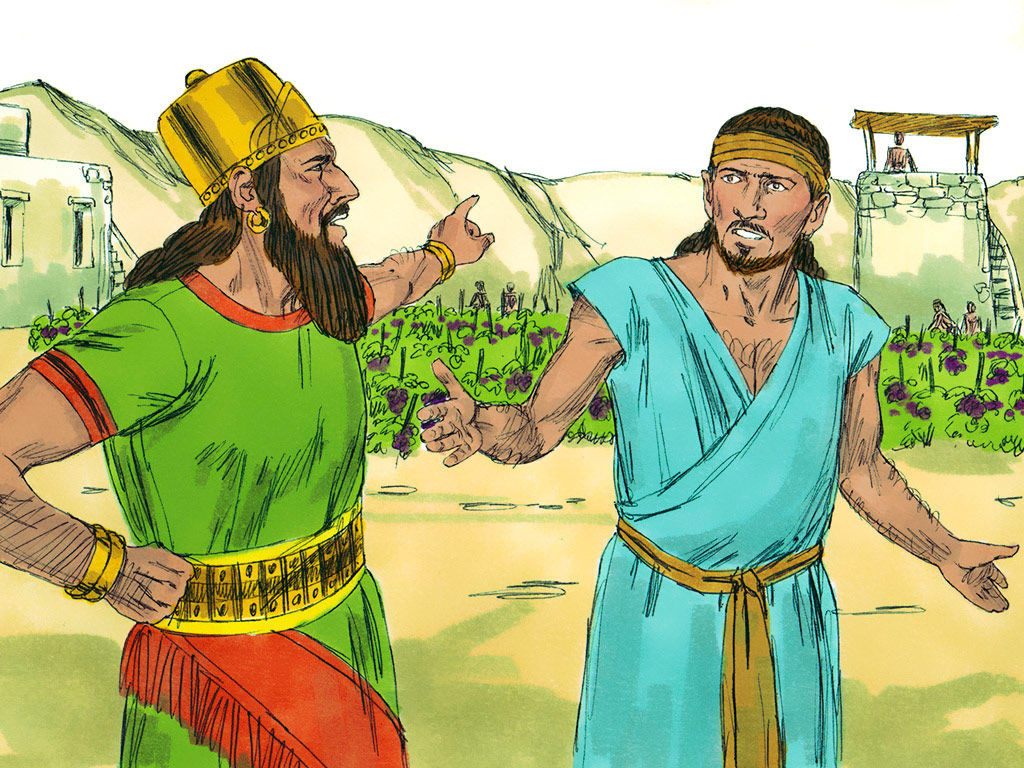
In our lesson from I Kings, we heard one of the stories of Ahab and Jezebel, the Bonnie and Clyde of ancient Israel.
In the chapter before our reading, Ahab is on his way home from war. He won but he let the defeated enemy go home with a treaty instead of executing him. A prophet catches up with Ahab to say that his disobedience will cost him his life. Ahab is “vexed and sullen” by this prophetic word. A more dynamic translation might be “he dug in his heels and burned with anger.” He’s rebelliously angry at God.
On his way home to Samaria, Ahab decides he’d like to own the vineyard next to his palace in Jezreel. Ahab’s capital is in Samaria, less than 25 miles south in a mountainous desert, but he has a winter palace that doubles as a cavalry fort in the warmer valley.
Ahab is upset after his encounter with the prophet. Remember, he’s vexed and sullen. And now Naboth’s vineyard has caught his eye. Is this retail therapy? An attempt at soothing his angry mood? Perhaps.
“Hey, Naboth, what a beautiful vineyard. I’d love to add it to my palace complex. I’ll trade you for the bigger vineyard on the other side of town. Or I’ll pay you cash for it now.”
Naboth doesn’t even think about it. He refuses to sell, but not out of a sense of greed or selfish ownership. Naboth appeals to God and to the Mosaic covenant. This may surprise us. They’re in the idolatrous northern kingdom. Still, Naboth is guarding his inheritance like he’s supposed to. Naboth knows that the Land belongs to God, and that his family is responsible for this plot. From Joshua’s conquest, tribes and clans and families were all allocated pieces of land to steward. The land goes from father to son (and even daughter) in every generation. One was not allowed to sell that land except when in dire poverty, and then in the year of Jubilee the land would be restored to the original family.
Naboth understands the responsibilities of covenant. He says something like “may I be cursed/separated from Yahweh if I give you the inheritance of my fathers.” No matter how good the offer, Naboth knows that selling the land would anger God. He’s not negotiating for more money. He is saying he is not able to sell for covenant reasons.
Ahab goes home to Samaria “vexed and sullen.” There’s that phrase again. “He dug in his heels and burned with anger.” Picture Ahab going home angrily muttering “I will not give you the inheritance of my fathers,” all the way home, for 20-something miles.
Ahab is burning with anger and he still wants the vineyard. He’s angry that his money was no good with Naboth, that his authority as king wasn’t enough to sway Naboth. Ahab’s brooding turns to petulance and depression.
While Ahab internalizes conflict, Jezebel is a woman of action. She sees Ahab’s despondency and thinks a solution up quick. It is a nefarious solution:
- accuse the landowner of two capital crimes,
- setup false witnesses against him,
- convict
- execute.
Naboth looks cursed as the town elders hurl stones at his dying body, as the dogs lick up his blood outside the city. His faithfulness to God costs him his property and his life. But he’s not cursed. He is a witness, a martyr for God’s covenant.
Jezebel and Ahab instigate the murder and the theft. But what do we make of the elders and nobles of Jezreel?
The inteligencia of Jezreel, the men of wisdom, stature, wealth, authority… they read Jezebel’s letter with Ahab’s seal, like mafia underlings, and said “Yes, boss” and orchestrated Naboth’s murder. Why? Did they fear men more than God? Did they love the potential vegetable kickbacks more than they loved their neighbor? Did they love their lives more than some dusty old covenant with the Creator of the Universe?
Hundreds of years later, in the high country just north from Jezreel, another man was chased out of town to be stoned. Except this time the man got away. He passed in the midst of them. Why did they want to kill him?
Because he spoke up for the Naboths of the world, the stranger, the oppressed, the imprisoned, the widows and the orphans.
“The Spirit of the Lord is upon Me,
Because He anointed Me to preach the gospel to the poor.
He has sent Me to proclaim release to the captives,
And recovery of sight to the blind,
To set free those who are oppressed,
To proclaim the favorable year of the Lord.”
Jesus speaks for the stranger not yet under the heavenly constitution. Birthright isn’t necessary to immigrate into the Kingdom of Heaven. All we have to do is stand at the Kingdom Gate and cry to the King of Kings for asylum. “Lord, save me?” And the King himself welcomes us in and washes us and clothes us and even feeds us with himself.
A few years ago, during my first visit to Poland, I stood in a gas chamber, and stared at the crematorium ovens, I walked around a pile of human ashes as tall as this building, I learned that the odd humps of grass nearby were the evidence of mass graves into which all the Jews of Lublin were murdered by machine gun. As I contemplated this on a Sunday morning, I heard the church bells of Lublin ringing. If I could hear the bells, the townspeople in 1942 certainly heard the screams and the machine guns, no matter how loudly the Nazis blared music in the camp. And they did nothing.
I could take it no more. The blood of 6 million Jews cries out from the soil of Europe. I shouted at God. Why?! So much death! So much sin! Sin as black as the night.
In that moment, I saw how big the Cross of Messiah is, how his blood washes away sin. I caught a glimpse of the radiant light of the Resurrection. In that Resurrection light I saw justice for those murdered in the Holocaust, for our murdered Armenian brothers and sisters.
We who come to the cross of Messiah and cry for asylum, we are accepted. And he washes us clean, and clothes us and feeds us with himself. And he cuts a covenant with us. “If you love me, keep my commandments.” “Feed my sheep.” Care for the stranger, the prisoner, the widow, the orphan. Our covenant calls us to mimic our savior. “Pick up your cross and follow me.”
The Spirit of the Lord God is upon US,
Because the Lord has anointed US
To bring good news to the afflicted;
He has sent US to bind up the brokenhearted,
To proclaim liberty to captives
And freedom to prisoners!
Speaking up against corrupt power is dangerous. It can be life threatening, as we see in Naboth’s case. Where is Naboth’s vindication? He will be vindicated just as the crucified Messiah was vindicated: in the light of the Resurrection. Naboth will rise again in resurrected life. He will hear, “Well done good and faithful servant” for his faithful stewardship, unto death. Our Armenian brothers and sisters will rise again. The martyrs of Nigeria, Sudan, China and Iran will rise again and rule and reign with our martyr King!
I cannot say it better than Peter:
Let us humble ourselves therefore under the mighty hand of God, so that he may exalt us in due time. Let us cast all our anxiety on him, because he cares for us. Let us be sober and vigilant; because our adversary the devil walks about like a roaring lion, seeking whom he may devour. Let us resist him, steadfast in our faith, for we know that our brothers and sisters in all the world are undergoing the same kinds of suffering. And after we have suffered for a little while, the God of all grace, who has called us to his eternal glory in Messiah, will himself restore, support, strengthen, and establish us.
To him be dominion forever and ever. Amen.